
Approved in November 2025 by the Union Cabinet and launched on 31st December 2025, the Government of India’s much-needed new initiative, ‘Market Access Support (MAS) Intervention’ Program under the ‘Export Promotion Mission (EPM)’, aims to strengthen and provide additional Global Market Access to Indian exporters globally.
According to the release issued by the Ministry of Commerce and Industry, Government of India, the new initiative will help exporters get noticed by facilitating their participation in overseas exhibitions, trade fairs, buyer-seller meets, etc., thereby increasing the visibility of Indian products & services in foreign markets. Through targeted support, MASI aims to assist exporters by reducing promotional costs, enabling them to connect with global buyers, and facilitating the discovery of new business/export opportunities.
Through the Market Access Support Initiative, financial support will be provided to eligible export associations, trade association affiliates, and eligible exporters participating in global marketing events.
This program shall work in conjunction with the current Export Promotion Schemes introduced to promote MSMEs, new enterprise development, and other exporter classes to access new & growing markets. It is anticipated that increased market access and marketing capability will improve the global reach & competitiveness of Indian producers & product groups, including textiles, engineering, chemicals, pharmaceuticals, agricultural products, and services.
It will not only add to the competitiveness of Indian exporters but also create opportunities for greater integration into the global value chain and contribute significantly to the economy.
The Government of India has operationalised a major export promotion initiative by launching the Market Access Support (MAS) Intervention, the first key component of the six-year Export Promotion Mission (EPM). With an initial outlay of ₹4,531 crore over the period 2025–26 to 2030–31 and ₹500 crore earmarked for the current fiscal year, MAS aims to strengthen India’s export ecosystem by enhancing global market access for Indian exporters and particularly accelerating the participation and competitiveness of Micro, Small, and Medium Enterprises (MSMEs) and first-time exporters.
The Market Access Support (MAS) Program
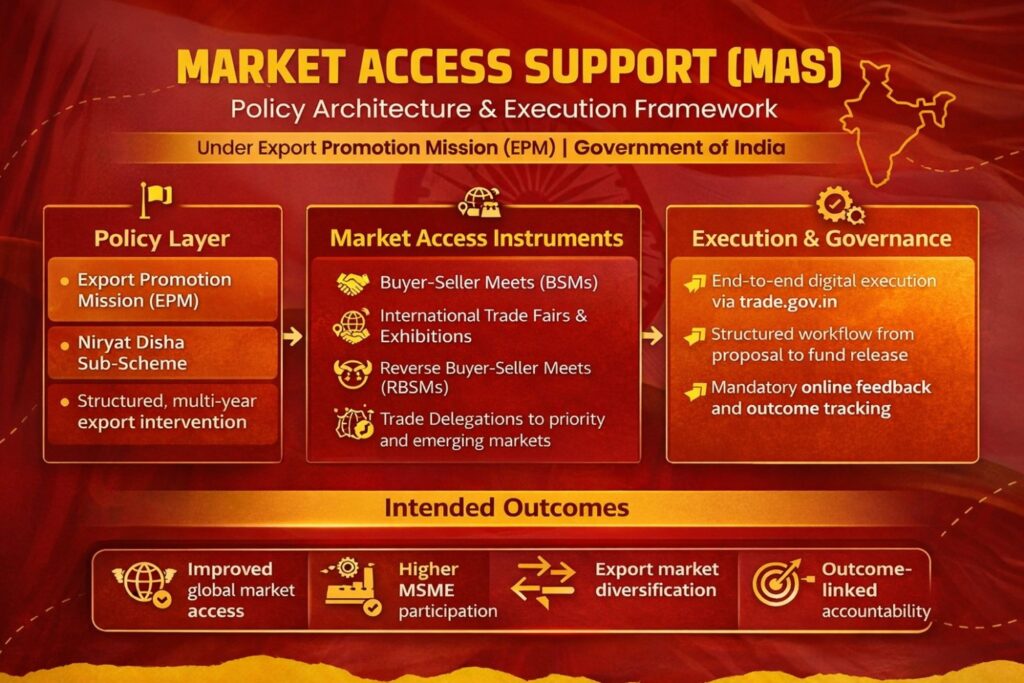
Market Access Support (MAS) is implemented through the Niryat Disha sub-scheme of ‘Export Promotion Mission (EPM)’. It’s aimed at providing structured financial and institutional assistance to Indian exporters for international market engagement activities.
Under MAS, the government will support exporters across the following key engagement avenues:
- Buyer-Seller Meets (BSMs)
- Participation in international trade fairs and exhibitions
- Mega Reverse Buyer-Seller Meets (RBSMs) in India
- Trade delegations to priority and emerging markets
- Support for partial airfare for small and first-time exporters
- Structured, forward-looking market access event calendar planning
All related processes, right from proposal submission, approvals, participation onboarding, and fund release, will be digitalised through the government’s trade.gov.in portal.
Why MAS Matters for India’s Export Ecosystem
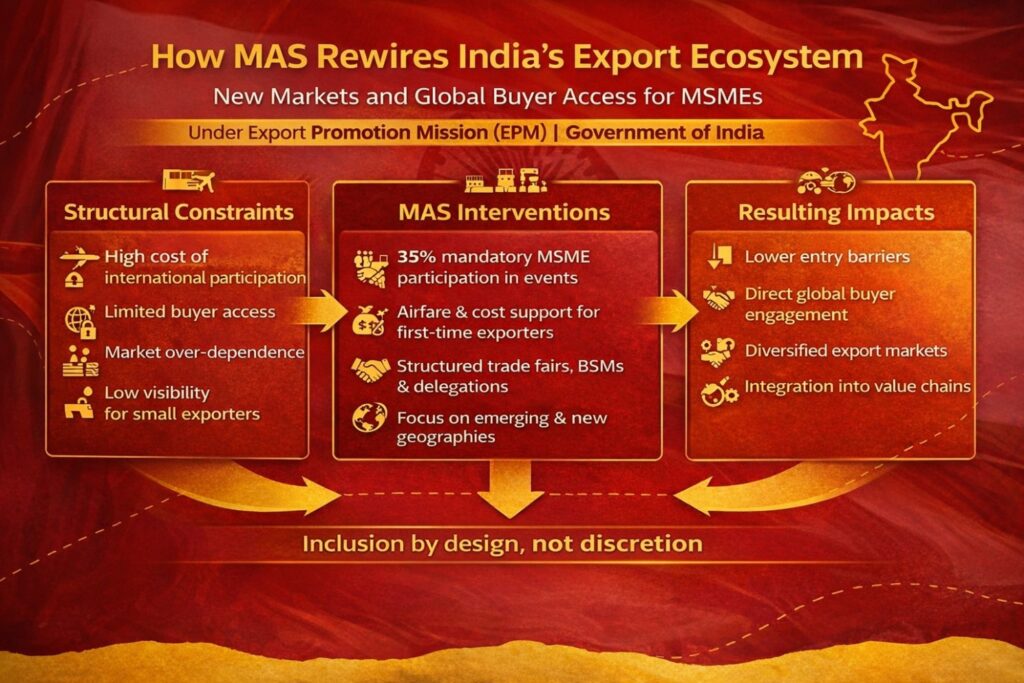
MSME and First-Time Exporter Focus: A standout feature of MAS is its mandatory MSME participation provision; at least 35% of participants in supported events must be MSMEs, ensuring that smaller players are not sidelined in global engagement initiatives.
Furthermore, companies with export turnovers up to ₹75 lakh in the preceding year will receive partial airfare support, significantly lowering the cost barrier for new exporters to connect directly with global buyers.
This is particularly important in India, where MSMEs constitute a large percentage of exporters yet often face challenges such as limited financial resources, lack of international visibility and restricted access to global buyers, challenges that MAS directly addresses.
Market Diversification and Risk Mitigation: In the midst of disruptive & fast-evolving global trade dynamics, including rising non-tariff barriers like steep tariffs up to ~50% imposed by the US, MAS is designed & aimed at helping Indian exporters diversify & create new inroads in non-traditional markets, such as Latin America, Africa, and other strategically important, emerging trade & business regions and global markets.
By encouraging participation in a broader set of markets and product categories, India reduces its dependence on a limited set of destinations, thereby strengthening export resilience against geopolitical and economic volatility.
Long-Term Planning and Predictability: A unique aspect of MAS is the creation of a 3-to-5-year calendar of major market access events, enabling ‘forward planning’and continuity in market development efforts. This represents a shift from reactive, ad-hoc interventions toward predictable, outcome-oriented engagement that gives exporters and organising agencies clarity and confidence to invest in global outreach.
Outcome-Based Framework and Feedback Mechanisms: MAS introduces mandatory online feedback mechanisms to track participation outcomes such as quality of buyer meetings, business leads generated and market relevance, feeding real-time insights into policy refinement. This represents a significant improvement in linking government support to measurable business impacts & results rather than just event attendance.
Short-Term Impact: Immediate Boost to Export Momentum
In the short term, MAS will likely deliver:
- Increased participation in international trade forums by exporters across sectors.
- Higher visibility of Indian goods and services, especially from priority sectors such as agriculture, textiles, leather, handlooms, AYUSH, telecom, defence and services like logistics, tourism and legal.
- More proactive buyer-seller engagement, leading to near-term deals and order flows.
- Alleviation of financial barriers for first-time and small exporters through airfare and cost-sharing support.
- Clearing of pending dues under earlier schemes like the Market Access Initiative provides immediate relief to exporters.
These will collectively help inject momentum into Indian exports, especially at a time when external demand is challenged by ‘protectionism and shifting global supply chains’.
Long-Term Impact: Sustained Export Growth and Global Integration
Looking ahead, MAS is poised to deliver structural benefits & effectiveness in:
- Enhanced Competitiveness: By facilitating systematic global exposure and consistent participation in major market events, Indian exporters can strengthen competitiveness, brand recognition, and product positioning internationally.
- Deepened Global Market Intelligence: Data-driven feedback loops will inform exporter strategies and government policy, enabling better targeting of markets, sectors and buyer segments.
- Stronger Integration into Global Value Chains: By connecting MSMEs to global buyers and supply networks, MAS can catalyse integration of Indian manufacturers and service providers into international value chains — a key driver of export sophistication.
- Export Diversification: With prioritisation of non-traditional markets and new geographies, Indian exports will become less vulnerable to demand shocks in core markets. This reduces concentration risks and builds a resilient, geographically diversified export portfolio.
Boosting the Indian Export Ecosystem: A Holistic Win
MAS is not merely a subsidy program: A strategic, multi-layered intervention that:
- Opens global doors for MSMEs and new exporters
- Addresses structural barriers in market access
- Aligns export promotion with data, planning and accountability
- Encourages diversification across markets and sectors
- Integrates MSMEs into global trading systems
Market Access Support (MAS) Initiative: Highlights for MSMEs
MAS goes beyond incentives; it fixes access, the single biggest challenge for Indian exporters, especially MSMEs and the new entrants, including the first-time exporters.
- Structured support for global trade fairs, buyer-seller meets & trade delegations.
- Mandatory 35% MSME participation, inclusion by design, not intent.
- Airfare & cost support for small exporters to step onto the global stage.
- Focus on new & emerging markets to reduce over-dependence on a few geographies.
- Digital, outcome-based execution with feedback loops and accountability.
The Beginning
India’s Market Access Support (MAS) Intervention marks a decisive shift in export policy, from reactive reimbursements to strategic market engagement, planning and partnership. With its MSME-centric design, digital transparency, cost-share models and emphasis on new markets and feedback mechanisms, MAS is built to unlock export growth sustainably for both small and large exporters.
As MAS unfolds over the next six years, it has the potential to power India’s export ecosystem to new heights, boosting export volumes, diversifying destinations, and elevating India’s role as a competitive global trading nation.
For exporters, especially MSMEs previously constrained by costs and limited market exposure, MAS represents a long-awaited opportunity, a structured bridge to global shelves, buyers and value chains, and a powerful engine for India’s export ambitions.
MAS: A Catalyst for Inclusive and Sustainable Export Growth
The Market Access Support (MAS) Intervention is not merely about boosting export numbers. Its core objective is to democratise access to global markets, ensuring that Indian Micro, Small and Medium Enterprises (MSMEs) are empowered to participate confidently in international trade. By facilitating broader participation, MAS helps to instil greater confidence among MSMEs and other emerging exporters, enabling them to navigate the complexities of global commerce with increased assurance.
Beyond enhancing exporter capabilities, MAS also plays a pivotal role in reinforcing India’s reputation as a trustworthy and credible global trade partner. Through structured support and a focus on inclusion, the scheme aims to build long-term relationships with international buyers and markets. Over time, these efforts are expected to lay the foundation for one of the most significant and far-reaching export reforms of the decade, transforming India’s export landscape for the better.