
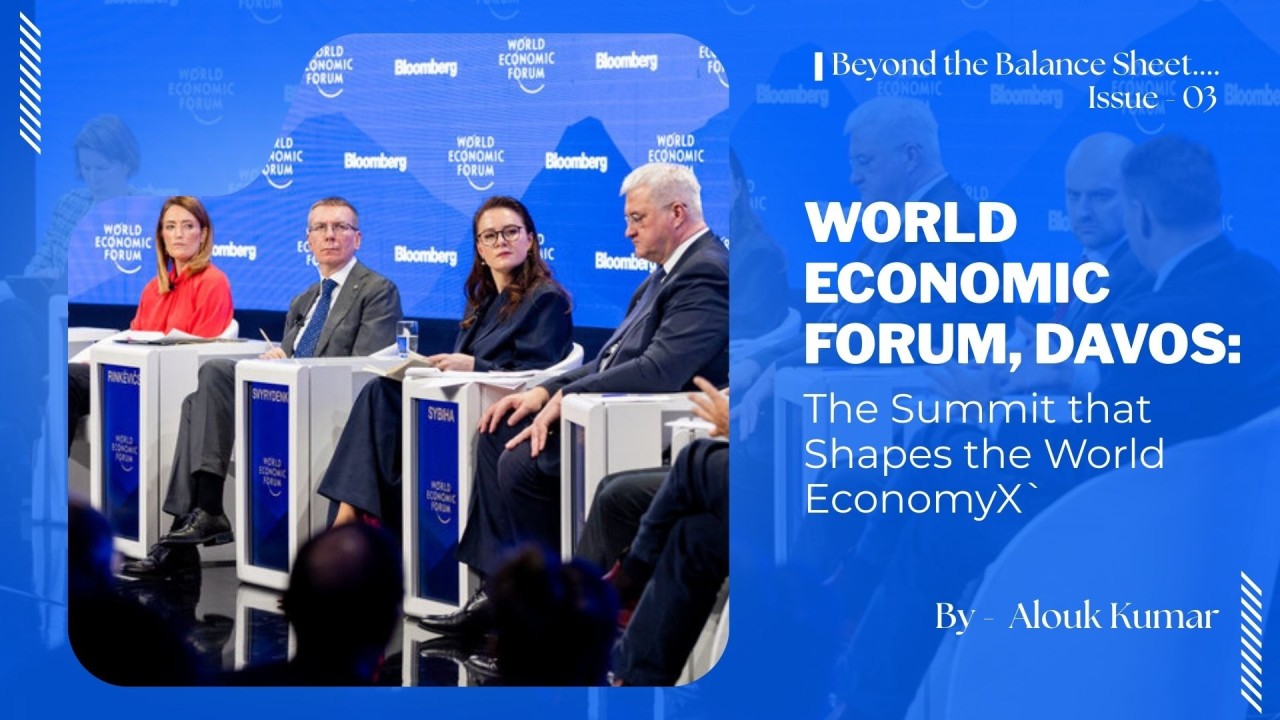
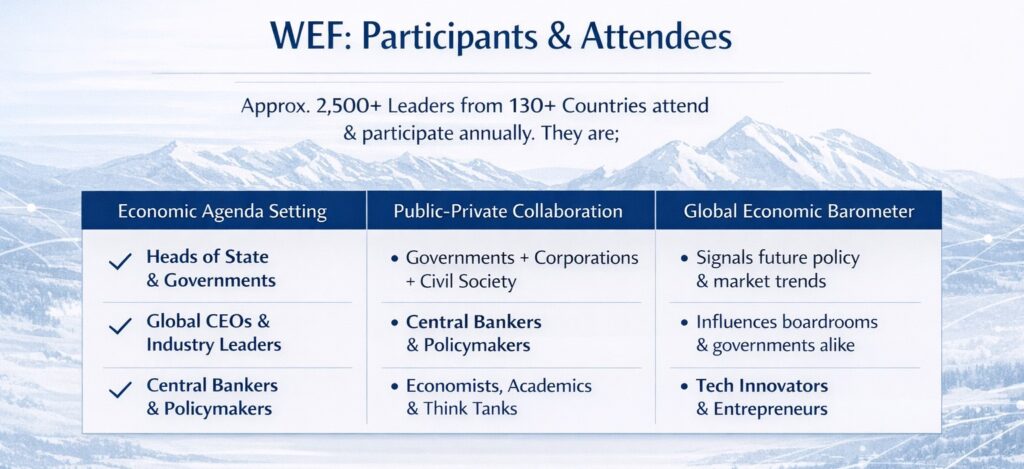
Every January, amidst the snow-covered peaks of the Swiss Alps, the quiet resort town of Davos becomes the epicentre of global economic dialogue. World leaders, CEOs of multinational corporations, top policymakers, leading academics, civil society representatives, and innovators converge at the World Economic Forum (WEF) Annual Meeting to address some of the most pressing issues facing the global economy today. This gathering, often referred to as “Davos”, has evolved from a European corporate retreat into perhaps the most significant global stage for public-private cooperation.
Origins and Evolution: From European Management Forum to Global Platform
The World Economic Forum traces its roots to 1971, when Klaus Schwab, a German business professor at the University of Geneva, organised a conference of European business leaders. His objective was modest but strategic: to help European firms adopt competitive management practices. That first meeting, held in Davos, brought together corporate executives under the banner of the European Management Forum.
As the world became progressively interconnected through trade and technology, the forum’s scope broadened. In 1987, the organisation adopted its current name, the World Economic Forum, reflecting an ambition to address not just corporate competitiveness, but global economic and political issues as well. Over the subsequent decades, Davos evolved into a neutral arena for dialogue on international conflict resolution, economic development, and global governance.
World Economic Forum: Journey & Evolution
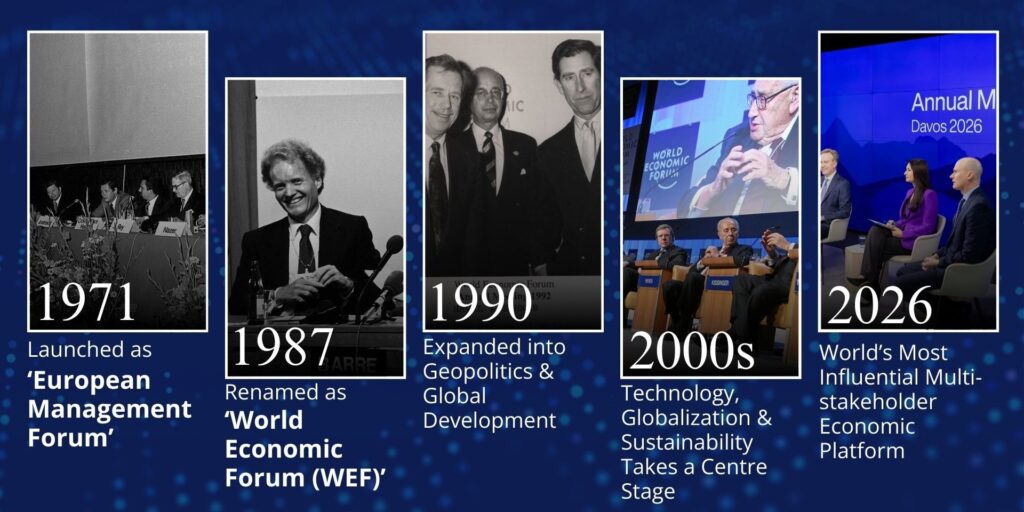
From peace negotiations between Greece and Turkey in 1988 to fostering dialogue that helped bring about the end of apartheid in South Africa, the WEF has played a subtle but meaningful role in international diplomacy.
Key Themes At Davos
- Technology & AI
- Climate Change & Sustainability
- Global Trade & Financial Stability
- Future of Jobs & Skills
- Geopolitics & Economic Security
- Inclusive & Equitable Growth
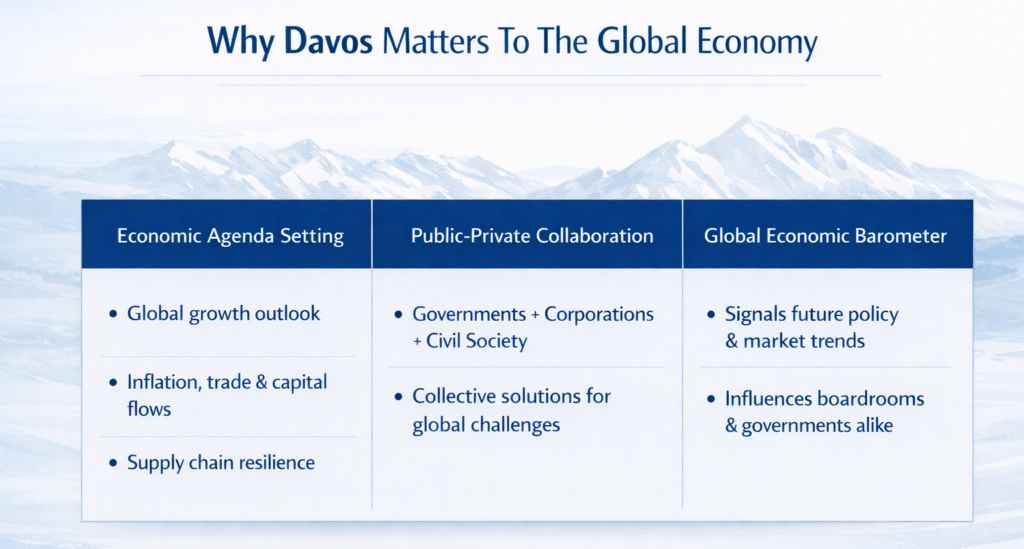
Today, the WEF Annual Meeting is widely regarded as more than just a conference; it is a global economic barometer. Each session, panel discussion, and informal corridor conversation influences the way governments and corporations think about economic trends, policy responses, and strategic challenges.
The forum’s agenda has expanded beyond traditional economic discourse to include themes such as:
- Stakeholder capitalism– promoting sustainable and inclusive economic growth that benefits employees, societies, and the planet, not just shareholders.
- Technological transformation – insights into the Fourth Industrial Revolution, digital transformation, artificial intelligence, and their implications for markets and labour.
- Global sustainability and climate action – sessions on decarbonisation, climate finance, and environmental stewardship.
- Social inclusion and equitable opportunity – dialogues on reskilling workforces, reducing inequality, and enabling economic participation worldwide.
The Davos agenda reflects a world of interconnected challenges where cooperation across sectors is more important than ever, particularly in harnessing innovation responsibly and building prosperity within planetary boundaries.
The Forum’s Impact on the Global Business Economy
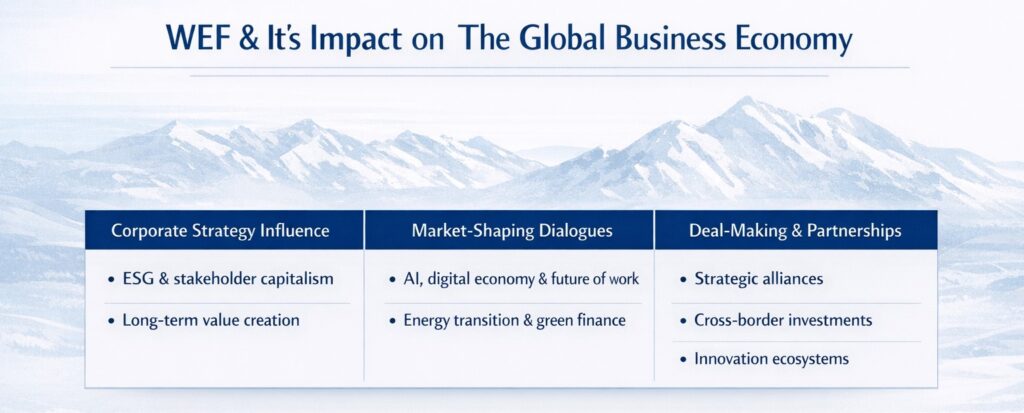
The WEF doesn’t dictate policy or make binding agreements, yet its influence on the global business economy is profound and multifaceted.
Setting the Global Policy and Economic Agenda
One of the Forum’s key roles is to shape the global economic agenda. The annual Global Risks Report and Future of Jobs Report, both produced by the WEF, are widely referenced by governments, international organisations, and industry leaders as touchstones for planning and strategy. These insights help countries anticipate economic disruptions and adapt their labour markets to technological change.
Building Public-Private Partnerships
Davos has emerged as the prime platform for forging public-private partnerships aimed at tackling shared challenges. Initiatives championed by the WEF, such as coalitions for vaccine distribution, digital inclusion, and sustainable supply chains, demonstrate how cross-sector collaboration can yield tangible results. For instance, the Edison Alliance succeeded in connecting one billion people to essential digital services ahead of its target.
Collaborations that Transform Markets
Beyond dialogue, the WEF’s role in fostering collaborative initiatives has had a lasting economic impact:
- The concept of stakeholder capitalism, promulgated at Davos, is now increasingly embedded in corporate strategies around the world, encouraging businesses to integrate environmental and social governance into their core models.
- Cross-border alliances developed through WEF networks have helped align global trade reforms, promote sustainable investment, and accelerate climate action, influencing how industries operate.
Networking and Relationship-Building
While keynote speeches at Davos attract headlines, the informal interactions, the coffee chats, one-on-one meetings, and chance encounters often yield the most significant outcomes. Deals, alliances, and investment commitments are frequently catalysed by relationships formed in Davos, from corporate partnerships to multilateral economic collaborations.
WEF’s Role in Shaping the Future of Global Business
As the global economy undergoes seismic shifts, driven by technological disruption, geopolitical tensions, climate imperatives, and demographic changes, the relevance of the WEF has arguably never been greater.
Governance in a Fragmented World
In an increasingly fragmented geopolitical landscape, the WEF provides what its leadership describes as a trusted and impartial platformwhere leaders can engage across sectors and ideologies. This kind of dialogue is crucial when global cooperation is required to tackle complex issues such as climate change or supply chain resilience.
Bridging Innovation and Regulation
As digital technologies, especially artificial intelligence, reshape economies, the WEF serves as a bridge between innovators and policymakers. At Davos, conversations on the ethical and economic implications of AI, including warnings about how AI could deepen societal challenges, demonstrate the forum’s role in steering technology towards inclusive and responsible outcomes.
Emphasis on Inclusive Growth
The Forum’s focus on inclusive economic growth suggests an awareness that prosperity must be broadly shared. Efforts like the Reskilling Revolutionaim to prepare millions of workers for the future of work, while alliances focused on refugee employment and digital inclusion aim to bring more people into the global economy.
Criticism and Controversies: A Balanced Perspective
Despite its prestige, the WEF has not escaped criticism. Sceptics describe Davos as an elitist gathering that reinforces existing power structures and is disconnected from everyday economic realities. Some argue that the concentration of business and political elites can inadvertently sideline voices from less influential regions or smaller enterprises.
However, the Forum has responded by broadening participation to include NGOs, youth representatives, and leaders from emerging economies, aiming to democratise the conversation and incorporate diverse perspectives.
WEF, Davos and India: Through the Eyes of the Emerging Economy
Initially, Davos appears to be a gathering of the powerful discussing with the powerful. However, in recent years, a different accent has been shaping the conversation. This comes from India, Southeast Asia, Africa, Latin America, and the Middle East, from economies that are no longer content to be discussed as ‘markets of the future’ but as drivers of the present.
As globalisation accelerated and growth shifted east and south, the World Economic Forum became one of the first global platforms where emerging markets did not just participate, but influenced direction. India’s growing presence at Davos is a telling example of this transformation.
What was once a forum dominated by discussions about aid and development has evolved into a space where countries like India speak about innovation, digital public infrastructure, manufacturing scale, climate leadership, and global value chains.
India at Davos: From Promise to Power
India’s journey at Davos mirrors its economic ascent. In the early years, India arrived with reform narratives, liberalisation, opening markets, and attracting foreign capital. Today, it arrives with confidence, scale, and solutions.
At recent Davos meetings, India’s story has been framed around
- Fastest-growing major economy
- Global manufacturing and supply chain alternative
- Digital public goods at the population scale
- Climate action aligned with growth
- A talent engine for the global economy
Indian delegations, comprising policymakers, CEOs, startup founders, and state governments, use Davos not merely to pitch India, but to shape global economic thinking on inclusivity, resilience, and sustainability.
What makes Davos especially relevant today is the recognition that the next phase of global growth will not be led by developed economies alone.
Emerging markets now account for
- The majority of global GDP growth
- The fastest adoption of digital technologies
- The largest workforce is entering the global economy
- The most urgent climate and infrastructure needs
Davos reflects this shift.
Sessions increasingly focus on
- Supply chain diversification beyond traditional hubs
- South-South trade and investment
- Financing development without debt distress
- Technology leapfrogging rather than linear growth
Davos as a Bridge, Not a Stage
For emerging markets, Davos serves a unique purpose. It is one of the few places where a minister from Africa, a startup founder from India, a sovereign wealth fund from the Middle East, and a Fortune 500 CEO can have a real conversation without protocol or hierarchy.
These interactions have quietly led to:
- Manufacturing investments shifting to new geographies
- GCCs and innovation centres are being set up in India and Southeast Asia
- Infrastructure funding aligned with long-term development goals
- Technology partnerships that bypass traditional intermediaries
Why Davos Still Matters for the Emerging World
In a fractured global order, emerging economies need platforms that:
- Allow influence without alignment to power blocs
- Encourage cooperation over confrontation
- Translate economic ambition into global partnerships
Davos remains one of the few such spaces. It does not replace multilateral institutions, but it prepares the ground for what comes next. For emerging markets, it is where intent meets opportunity.
Looking Ahead
As the world economy confronts the twin challenges of rapid technological change and persistent inequalities, Davos remains a central forum for charting collective action. Its evolution reflects a pragmatic response to an increasingly complex global landscape, one where cooperation among public, private, and civil society stakeholders is indispensable.
Even as institutional leadership at the WEF changes, with founder Klaus Schwab stepping down from his long-held role, the Forum’s mission continues to resonate. Its ability to adapt, convene diverse voices, and influence both economic thought and practice positions it as a crucial hub for global dialogue, well beyond its snowy alpine setting.
Davos in a Fractured World
In recent years, Davos has felt different.
Geopolitical tensions are sharper. Trust in institutions is thinning. The optimism of globalisation has given way to caution. The tone has shifted, from growth to resilience, from expansion to stability, from ambition to responsibility.
Yet Davos persists, not because it has all the answers, but because the world has fewer places to ask the right questions together.
In an era of polarisation, Davos remains one of the last spaces where dialogue still outruns dogma.
Conclusion
The World Economic Forum (WEF) in Davos has transcended its origins to become one of the most influential platforms shaping global economic discourse. By fostering dialogue between the world’s most powerful actors, the Forum influences how economies evolve, how companies strategise, and how governments respond to global challenges. While not without criticism, Davos remains a vital melting pot of ideas where public-private cooperation can spark initiatives that transform industries, empower societies, and steer the global economy toward more sustainable and inclusive growth.
In an age of unprecedented economic and technological disruption, the Forum’s mission to “improve the state of the world” by bringing together stakeholders from every sector is both more relevant and necessary than ever.